Starting The Job Search? Think Again

Original Post: Starting The Job Search? Think Again

Though it sounds brash, I think it’s the wrong mindset to “officially” start the job search. Sure, you can sit down and think, apply for things and make a plan. But let me ask you a question: Shouldn’t you always be on the job search?

In some fields, “starting” a job search is the traditional way to approach it. In this traditional mindset, you can attend career fairs and join a relevant organization your senior year of college to have something on your resume. Well, this isn’t the case if you’re seeking a career in communications.

job search

You should always be on the job search. Always. From freshmen year of college (and even before) through the rest of your career, always be on the job search. It doesn’t mean you have to be interviewing for positions and actively submitting your resume to online sites. (How many times have you earned a job or internship that way?) However, I think it’s good to always be thinking ahead. It’s all part of being strategic about your career.

Here are some principles of a constant job search:

  • Networking. I probably say it too much, but it’s important to realize that networking should be something you’re always doing. You can always attend networking events, but it only will help you if you meet new people and keep the relationship going. Networking is also a two-way street: Find ways to help the other person and they will help you back. Also, make friends online. Communicate on Twitter, get active in chats such as #PRStudChat and give back to the community.

  • Professional Development. Are you waiting on joining an organization? Are you making excuses to not attend industry conferences? Are you finding new ways to build your portfolio and learn new skills? Those are important questions you should be asking throughout your career. You can always get involved with professional organizations and attend their conferences, but it’s a good idea to couple that with doing things on your own. Starting a blog, volunteering and reading are great places to start.

  • Curiosity. Never be afraid to ask big picture questions and about why things happen the way they do. It’s especially important for those early in their careers to get used to doing. This helps build a strategic mindset, and that’s how you will get ahead in your career.

  • Be uncomfortable. Though it might seem difficult and challenging, you should never be comfortable. If you’re doing the same thing over and over again with no chance of advancing, you’re going to be stuck in the status quo. Look for ways to try new things and meet new people. These new perspectives can help build your value to any organization.

If there’s one thing this recession has proven, it’s that companies are shifting more quickly than some employees can keep up with. That’s why this mindset is not only important for young professionals, but more seasoned professionals, too. I’m graduating in about a year and a half, but you bet I’ve started my “job search” a while ago and will continue to do so after entering the workforce.

What else would you add as characteristics of a constant job search?

4 Tips for Turning Yourself into a Brand How to Brand Yourself

Original Post: 4 Tips for Turning Yourself into a Brand
 

How to Brand Yourself

Getting from one level to the next in your career can be a tough climb. In all my years as a recruiter, I found that the number one reason professionals fail to advance is that they don’t realize their worth — or how to capitalize on it.

Most professionals undersell, understate and/or outright don’t take stock of their skills and accomplishments. So, how do you brand yourself for career advancement? Following the steps below will put you well on your way.
 
1. Assess Your Skills & Abilities. I mean, really take stock. Don’t look at your existing resume.

Start with your current position and list every project you’ve worked on, every dollar you saved, every new skill you mastered, every client who’s bottom line you increased.

Just make a list - no matter how minute the project, dollar amount or skill. Dollars to doughnuts, you have quite an impressive list in front of you. Many professionals don’t ever take the time to do this type of in-depth skill analysis.

Okay, you have your list. Now what?
 
2. Organize Your List How? I’d separate them into categories. Depending on your profession, they may look something like:

Sales Increased: List all cases where sales increased because of your input (eg, project you headed, direct mail campaign you wrote copy for, reorganization you structured, etc.

Dollars Saved: Similar to the above, list all instances where you saved a client/company money either directly or indirectly.

Skills Mastered: Did you take an HTML class? Did you go on a leadership retreat to master new management policies? Again, whatever skill it is you’ve mastered - whether it be a hard skill like coding, or a soft skill like employee management - put it in this category.

Projects Headed: If you spearheaded a project, list it. Eg, did you convert client files from QuickBooks to Peachtree, a new software you learned? Did you create a filing system to track client images? Did you create a new layout and design for a client brochure?
 
3. Create a Professional Profile If you’re a freelancer, I advise that you submit professional profiles to potential clients, not a resume (this subliminally says I’m an employee/I want a job).

A professional profile says that you’re an independent consultant who can help a potential client increase their (insert client objective). Eg, sales, customer subscriber list, client retention rate, etc.

If you’re a full-time employee, I would create this category on my resume. You can name it any number of ways, eg, Professional Profile, Professional Summary, Career Highlights, etc. It’s up to you.
The point is to create a place where, at a glance, potential employers can grasp what you can offer.
 
4. Market Yourself This is where many professionals - freelancers and full-time job seekers alike - fall down. YOU are the product. Market yourself.

Create a professional website and/or create a blog. When you apply for positions/gigs, direct potential clients/employers to this.

Even if you are currently employed, it can be helpful to create some type of online professional preference, if only to keep track of your accomplishments as they happen. Then, when you are ready to move on and/or branch out on your own, all you have to do is make it “Live.”

In today’s ever-competitive professional environment, it’s those who are able to effectively sell themselves who get the plum jobs/assignments. Don’t be left behind.

Brand the thing you know the best - you!

Yuwanda Black is the publisher of InkwellEditorial.com: THE business portal for and about the editorial and creative industries. Don’t want to ever worry about “career advancement” again? Start a freelance writing career! It’s fast, simple and easy. Learn how at InkwellEditorial.com

Brand Yourself Before Someone Else Brands You

Brand Yourself Before Someone Else Brands You


Discovering your personal brand is the first step in the personal branding process for a reason. If you don’t know what you’re brand is then how are you going to convey it to the world? Your brand is what you will be known for. When your name or image is seen or heard, what will people say? Will that description or single word be what you want them to think? These are all questions you need to ask yourself now, not in five years! The reason is simple: brand yourself before someone else brands you.

The internet has promoted perception over reality, which is both a threat and an opportunity. A first impression is obviously the most important and if it’s not perfect or authentic, then you will lose that opportunity, whether it’s a possible job, speaking engagement, friend, etc. There are no second chances, especially now since there are an infinite amount of people and websites that are easily accessible and free to the world.

You will be judged based on what appears online in many different situations, such as:
  • Google: Your name is google’d and the first result is clicked on. You will be accessed based on that single website they click. If you were prepared and had created content, joined social networks and had your own domain name, then you could, for the most part, know what that first point of contact would be. That is a huge window of opportunity to make an impact.

  • Facebook: I always say that Facebook does more harm than good. Recruiters, for instance, use Facebook to conduct background checks more than any social networks. It’s very challenging to build a “professional” brand on Facebook, as you can easily do with LinkedIn. When people search on Facebook, depending on your setting, your name and picture may show up. If the picture is you doing something suspicious, then you lose out. Your Facebook profile might rank first in Google, which means that becomes your first impression in the above example.

  • Domains: Some people will type in your name as a domain name without using a search engine. Did you purchase your domain name? If you didn’t, it will show them that you aren’t thinking about personal branding and that you don’t have a great web presence. Go to GoDaddy.com and use the promo code “oyh7″ to purchase a $7.15 domain name. Try and get yourname.com or yourname.net.

  • Shared content: The latest and most interesting first impression machine is content shared through social networks. For instance, let’s say you never heard of me before. Someone shares a link to a poorly written blog post that I wrote two years ago and another person clicks it. That would be a bad first impression through shared content. This means that everything you do has to be high quality, consistent and portray a positive image of your brand.

  • Other social networks: I mentioned Facebook above, but people are searching for you on industry networks, LinkedIn and maybe using tools like Twitter search. Based on what your the search results are for your name in Google (this could be Yahoo! or Bing now too), it will create an impression.
It’s hard to have control when people are sharing your contributions just about everywhere these days, at a pace that is like lightening. That being said, you still can take control of your online image, such that you know what impression you’ll make making so you can capitalize on it. For the most part, everything I mention below is something you can create, control and/or influence.


5 ways to own your Google search results:
  1. Domain name: As said above, claim your domain name right now. You should then put up at least one web page that people can access from this domain and so it becomes “crawlable” in various search engines. I recommend taking your resume, splicing it into different sections, such as “education” and “major projects,” and then having one page that talks about each.

  2. Social profiles: Social networks have very high Google PageRanks (Facebook=9, LinkedIn=8, Twitter=9), which means that once you create a profile, give it a unique URL and establish it, it will more than likely rank high for your name in search engines.

  3. Content: The best content you can create is in the form of a blog because it’s refreshed a lot (if you put work into it) and therefore ranks high and is shared more. You can also upload videos to sharing sites like YouTube or Vimeo and write for other blogs and/or news sites.

  4. Press: When a publication or blog writes something positive about you, especially if your name is in the title of the story, it can rank high as well, as well as give you traffic and credibility with that audience.

  5. Search engine optimization (SEO): Before, during and after you perform the above four strategies, you’ll want to think about how you can influence search engines. For example, if you want to own two keywords in the minds of your audience and dominate your niche, then you want to use them in the title and description field of your website or blog. There are many other SEO strategies out there, but since content is king, those with the best content will get the most links and therefore conquer search engines anyways.
Well, it depends on your mark of highest visibility. What I mean is that if you’re really success doing something you hate and you don’t invest the time to think about your branding, then you will always be known as something you despise. On the other hand, if you understand your brand and everything you touch has that branding, consistently, over a long period of time, then it will start to resonate with your audience. People brand other people very fast. It might have to do with what you’re wearing, if you’re beautiful or not, how you respond to a question or what your profession is.

The end result is that your audience is confused about what you do, what value you can provide to them, what your values are and your mission in life. There is no going back either. You can’t run down the hall and explain to them that you are someone different than you may have appeared. All bets are off. You probably don’t want to be known as the lazy intern or the drunk executive!

Pick a brand and stick with it!

You need to brand yourself even before someone even meets you in the first place. That way, the conversation is less of an introduction and people draw a line between who you are and what you do. I’m not saying that you won’t evolve your brand over time, but I’m trying to make the point that consistency is encouraged and preparation and execution are everything. When you’re not in a position doing what you love, then it’s hard to brand yourself based on who you are. When that happens, you’ll be branded based on a life you don’t want to have and nobody wants that. So take the time and think about what type of impression you want to make and what you want to be known for.

Will Social Security Be Around When You Retire?

Will Social Security Be Around When You Retire?


For those of you outside the U.S. or who don't know, Social security was founded by President Franklin D. Roosevelt in 1935. It has undergone some changes since then, but is essentially a government assistance program to provide retirement, disability, and survivor benefits to beneficiaries funded by U.S. tax dollars.

The Social Security Statement


We just received Linda's Social Security Statement containing her earnings record and estimated benefits. Within the envelope they included a pamphlet titled "What young workers should know about Social Security and saving." I am not planning on Social Security being around when I reach retirement age, because you can only go so long spending $2 when you are only making $1. With all the Baby Boomers retiring, there is just going to be a lot more money going out than what is being contributed. You hear concerns about this all the time, but I was interested to find out what the Social Security Administration had to say about the future of the program.

From the Pamphlet…
Will Social Security still be around when I retire?

Yes. The Social Security taxes you now pay go into the Social Security Trust Funds and are used to pay benefits to current beneficiaries. The Social Security Board of Trustees now estimates that based on current law… In 2017 (it) will begin paying more benefits than it collects in taxes andin 2041, the Trust Funds will be depleted (emphasis added). Because people are living longer and the birth rate is low, the ratio of workers to beneficiaries is falling. Therefore, the taxes that are paid by workers will not be enough to pay the full benefit amounts scheduled.

… Even if modifications to the program are not made, there would still be enough funds in 2041 from taxes paid by workers to pay about $780 for every $1000 in benefits scheduled.

Wishful thinking?

While I am pleased that the government is being honest about challenges ahead for the Social Security program, I think their estimates are very conservative - if not wishful thinking. The way healthcare technology is advancing we will probably be able to keep everyone alive to 100+ in a couple decades - whether they like it or not! ;) I would be surprised to an increase in our birth rate, and I think seeing a continuing decrease is much more likely. So with both ends extending out, we will likely have a much larger disparity of cash inflows vs. outflows than we do today.

But knowing our government, they will try to find a way to make it work. They are going to have to pay the piper eventually, but no one seems to know when that day will come. Assuming they can always find more money to borrow (a dangerous assumption IMO) things will work out fine and we will all get our Social Security checks each month.

Depending on Social Security for retirement

If you can't tell, I do not want to be in a position where I have to depend on the government to be able to retire. When ever people ask me about it, I always tell them the same thing - Plan for your retirement like Social Security will not exist. If it is still around, then you will have a nice little bonus. But a lot can change in a decade or two and in the case of Social Security, I don't think it will be in their benefit.


"

10 Twitter Tools to Effectively Manage your Followers

Original Post: dailyseoblog.com by Mani Karthik
Managing your followers and friends on Twitter is not easy. But its a fact that your success ratio and influence power is directly proportional to how active your followers are. I’ve realized that rather than who follows you or how many people follow you, its important to know whom you are following and how active they are.
Some of the factors that will determine your influence power on Twitter are
- How active your followers are.
- Do they ReTweet your tweets.
- Whether they are regularly updated and have a good following.
- Are those whom you follow, following you back etc.
With the default options on Twitter, its not really easy to manage your followers, but here are some interesting web based applications that I found to be of great help. Hope you find them useful too.
Twitter-tools
Twitter bird icon courtesy – Aravind Ajith
1. Mass Unfollow those who are not following you back with Huitter
I believe that there is no use in following people who aren’t reciprocating on Twitter. I use this tool weekly, to check for people who aren’t following me back. It automatically unfollows everyone who aren’t following you back. Huitter.mass-unfollow-tool-huitter
2. Automatically unfollow all inactive accounts you are following with MyCleener
This is yet another tool that will help us automatically unfollow all the inactive accounts based on when their last tweet was, and help you save your follow number. MyCleener
automatically-clean-inactive-accounts
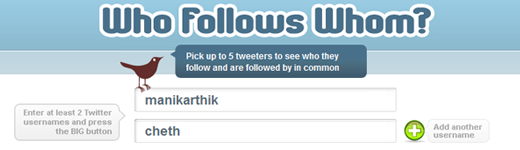
3. Find out common users following and being followed by two accounts
This is a great tool, because if you knew two power user accounts, say from your niche, then you can find out who are the guys they keep in contact with and who are the guys they are following and followed by with this tool. Running this tool with maximum five accounts will more or less reveal the “hidden” circle among them. Very effective if you know whom to stalk. Who follows whomwho-follows-who
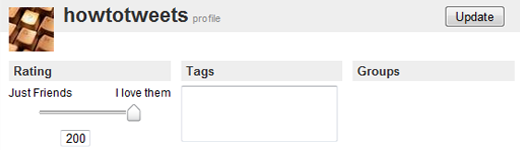
4. Manage your friends and followers with tags
This tool lets you rate and tag your friends and filter them on a timeline! You can also create custom groups of your followers and filter you timeline by that group. Very effective, but a little complicated to use. Twittangletwittangle1
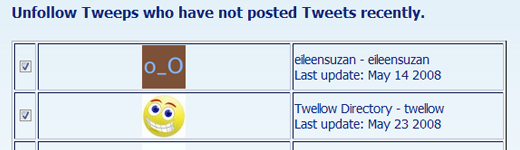
5. Unfollow people who have not updated within “X” amount of days
This is one of the best ones out there. It lets you find out the tweeps out of your followers who have not updated within a specified number of days (you can decide how many days is it) and lets you unfollow them. Extremely helpful when it comes to keeping your followers group healthy. Untweepsunfollow-inactive-users
6. Find out which Tweet made you popular and which one un-popular
One of the things that’s frustrating about Twitter is the un availability of a tracking mechanism. I personally would like to know what was that one tweet that got me popular and which is the one tweet after which people unfollowed me. Very effective in finding out what people expect from you and what they don’t. This tool helps you find just that.Tweet Rank (it’s German, you may want to translate it to English.)tweet-rank
7. Find out your ReTweet Rank
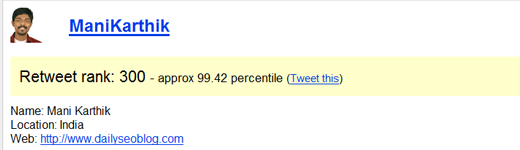
ReTweets I believe are a good measure to find out how popular your tweets are. This site picks up all the re-tweeted stories and grades you based on the number of re-tweets. Though its not sure what the algorithm is, its a nice tool to find out where you stand. Retweetrankretweet-rank
8. Find out who’s following who on Twitter
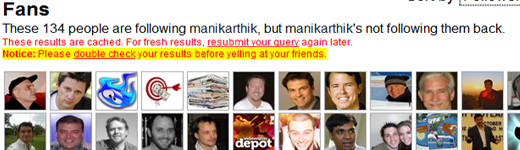
Well basically this tool helps you to find out if those people you are following are following you back or not. Shows you the number of friends, fans and followers. But I use it for a different purpose. If I find out a power user in my niche who is popular and is often re-tweeted, I would like to find whom he is following and what are his sources. Simply use this tool, give in the username and it will show who all are following him, his friends and fans. The good thing is that you can sort them by the number of followers they have. So if you want to steal a power users “precious friends”, this tool comes in pretty handy. ;) Friendorfollowfriendorfollow
9. Find out common followers between accounts
If you’re unsure whether to follow someone or not, just use this tool to find out if you have common interests and whether there are guys you are following in common.TwtrFrndtwitterfriend1
10. Find relevant and interesting Twitter users to follow
As I said earlier, a good twitter life is all about following and keeping in company with the most active and interesting Tweeps. And Mr.Tweet is one damn tool that lets you connect with them. I mean, its a very simple concept executed in an awesome way. It shows interesting profiles and stats such as they are active or not, responds to tweets or not and whether they’ll follow you back. Mr.Tweet
mrtweetMost of these tools require username and password, so use them wisely. Hope you like them.
UPDATE
Thanks to Mark, who introduced this tool called Tweepular to me. I wish I had known them before making this list. It is “the” best tool I’ve found so far. It has almost all the features I can think of for managing followers. Do check it out and you’ll quit using all others.
tweepular


How To Win Your Local Job Fair

From Consumerist

The anonymous, newly unemployed personal finance blogger behind Well-Heeled with a Mission put together a timely, helpful guide on how to avoid wasting your time at job fairs and actually come away with the experience with some positives rather than feel as though you've wasted your time in a cattle call.

Well-Heeled advises you prepare exhaustively for the fair, boning up on the top two or three companies that interest you, focusing on them at the fair, then following up with short, polite e-mails afterward.

The key to it all, she writes, are knowing what you're getting into before you head out into the fray. Here are her top three pre-fair preparation tips:

1. Determine if this job fair is worth your time and effort. Look at the requirements for attendance – for example, some fairs require a 4-year degree, others don't. Some fairs are specialized (i.e. teaching professionals or high-tech workers only), others are general. Look at the location (is it 15 minutes away? 3 hours away?).

2. Go over the company list and pick 2-3 companies that are your top choices.

3. Spend 30-40 minutes researching your top choices, particularly on any programs / specific functions you are interested in. Spend another 10-15 minutes studying a few other companies that you are interested in.

She follows up with some key advice to avoid getting a speeding ticket on the way home. It's advice she says she learned the hard way last week.

Do you have any additional advice for job fair navigating or job seeking in general?

Making The Most Out Of Job Fairs [Well-Heeled, with a Mission]
(Photo: Lisa Pisa)

Old Workers Vs. Young In A Tough Labor Market

Original Post: Consumerist

Forget about mall-walking and midday bingo games. It seems that workers over 55 just aren't interested in retiring. This is problematic for the young people who, under different circumstances, would have replaced them in the workforce.

These observations come from a new Pew Research Center report, which looks at current workforce trends and predicts what may happen in the near future. So why are people over 55 staying at their metaphorical desks? For many of them, it's not because of the hit their investments have taken—it's because they want to stay engaged and relevant.

When asked to identify specific reasons for working, older workers emphasize psychological and social factors: 'to feel useful'; 'to give myself something to do'; 'to be with other people.' Younger and middle-aged workers are much more inclined to cite classic pocketbook considerations: 'to support myself and my family'; 'to live independently'; 'to qualify for retirement benefits'; 'to receive health care benefits.'

Meanwhile, fewer Americans between ages 16 and 24 are employed or looking for full-time work, and they are generally remaining in school because of the number of jobs that currently require college education of some sort. Or because school is a much safer place to be than the job market right now.

Recession Turns a Graying Office Grayer [Pew Research Center] (via Consumer Reports Money)

(Photo: Hitchster)