Indeed Ranks the Most Crowded Job Markets [Job Search]

Indeed Ranks the Most Crowded Job Markets [Job Search]: "


Indeed, a Hive Five winner for best online job search site, posts a ranked list of U.S. cities, showing off the ratio of unemployed folks in a city to the job listings Indeed can find for it.

It's far from scientific, as both Indeed is not the absolute standard for job finding, and not every unemployed person is hunting for jobs in that city. But it is intriguing data porn—and thoroughly disheartening for those living in California or, like certain Lifehacker editors, upstate New York. If you're hunting for a job, this list won't preclude you from landing a great gig in any of these cities, but it might help you prioritize where you spend your energies.


No One Cares About Your Resume, and Why You Should

This post was written by Daniel Bowen and originally appeared on his blog Young And Frugal, a site dedicated to Business and Personal Finance for Generation Y. If you like what you see here, be sure to check out Young And Frugal. Original article here

NEWSFLASH: No one cares about your resume.

What's that you say? You've spent hours perfectly crafting every word in order to make yourself look fantastic on paper? You even read my advice on resume building? That's very kind of you, but I repeat, no one cares, and here are 5 reasons why.

  • Resumes are boring. No one wants to read them, not even recruiters. It's a chore that takes time, and realistically the last time you did read one (instead of glance at it) was when you were writing your own.
  • People are lying to protect your feelings. When was the last time you or someone you know told a friend you wouldn't forward their resume on because it was crap? When was the last time you asked for resume advice and everyone told you it looked good? Friends think a lot of things, but very few friends will be brutally honest to help you, if no one is giving you constructive criticism try sending it to other people.
  • Your resume won't get you a job. Do you really think someone is going to hire you based on a piece of paper?
  • You're exaggerating. Everyone does it to a point, but did you really collaborate with the team on the $300 million dollar project, or did you just make copies for them? If by chance someone does read your resume, they are reading it with a skeptical eye and taking it with a grain of salt.
  • You are sending it into a black hole. Applying online? Unless you have a persons e-mail address not a generic recruiting address, it will most likely never be seen by  a human eye. Even if you are sending it to a real persons address, remember it's a chore to open it and they probably don't want to.

With all this said, it's true, no one cares about your resume, but you should still care. As much as it kills me to say it, resumes are still very important, and here are 5 reasons why:

  • It's not for other people, it's for you. Your resume should be a running tally of every impressive thing you have done, and you should use it as a refresher to remind yourself of these things. It should be up to date whether you are job hunting or not, and when you accomplish something of note, write it down. You can always shorten your resume, it's very hard to lengthen it. Know your resume backwards and forwards and be able to expand on everything on it without fumbling. Even know what doesn't make the final cut, your resume will help you in the interview (but be careful to not only talk about what is on the resume).
  • It is currently the most accepted way to showcase yourself. We are fast approaching the days when someone will say "send me your link" instead of "send me your resume," some early adopters have already started this with LinkedIn, however, for the time being the resume is still the most accepted way to showcase yourself.
  • Key words help you get a foot in the door. Remember that black hole I wrote about? There is a way out, and that is through key words. More often than not applying to a generic recruiting e-mail address will send your resume into a software program in which it will be looking for key words. If it matches the key words, then someone might look at your resume to see if you fit the bill and invite you in for an interview. So remember to use industry language. (Note: although this is my most hated form of applying for a job, I actually did get my current position this way. It never hurts, but don't get your hopes up.)
  • Be true to yourself. A little embellishment is expected but always be true to yourself and NEVER lie on a resume. Lying on a resume is career suicide and it will come back to haunt you. It is better to not get the job by being honest, than to get it by lying. Just ask George O'Leary, former head coach at Notre Dame who was forced to resign because he lied on his resume.
  • It won't make you, but it can break you. First impressions are important, and the resume is frequently someones first impression of you. While it may not make you, it can definitely break you, so in the off chance that someone actually looks at your resume, it needs to be easy to read and perfect. One misspelled word and you are through.

As Gen-Y becomes more of a staple in the work place I see a lot of this changing, particularly the accepted resume format. I believe we will transition to websites with professional bios being the standard (non-boring) way to showcase yourself. But in the meantime, I'll continue my love/hate relationship with resumes.

Common mistakes. Easy fixes. (part two)


from getpickd

This post is part two in a series on common mistakes made by job applicants and easy fixes for addressing those mistakes.

Warning: Arriving early to an interview may adversely affect your chances of being hired.


It is important to show up on time for an interview. This is a rule of thumb that won't come as a surprise for most readers of this post. Incorrectly, most job applicants believe it is important to simply not arrive late to an interview. However, it is nearly as important to not show up more than five minutes early either. With many employers, arriving too early for an interview is only a slightly lesser offense than arriving late.

Why is arriving too early a blow to your chances of winning the job? The answer is quite simple. One of the primary goals of the interview process is to determine a prospective candidate's understanding of, and ability to operate within, the norms of a professional environment. One of those norms is an understanding of how your actions impact others around you and your respect for your co-workers schedules and time. Showing up early, or late, for an interview (or for any business meeting) is disruptive to the person you are meeting. To understand this, consider what occurs when you arrive early. The people with whom you are meeting will be notified that you have arrived. From a cultural perspective, most people don't feel comfortable making someone wait for them as it is considered rude—so the person you are meeting now has two options: a) they can interrupt their schedule to meet with you early, or b) wait for the scheduled time and be made to feel anxious about making you wait. In either case, you have made a bad first impression.

As an employer, I understand the motivation to arrive early for an interview. As with any meeting, you want to build in enough time so that you can be reasonably sure that you can find the location, and be prepared if any unexpected transportation delays occur. Building in a buffer for these things is smart, but it means that you will often arrive at your destination earlier than the scheduled start time. If you arrive 10, 20, 30, or more minutes early, find something else to do with your time. Find a coffee shop and read the paper, tour the neighborhood, or check out the local bookstore. Just make sure not to lurk pensively outside the office suite—this just makes people nervous. You should not actually enter the office suite where you are interviewing until five minutes before the scheduled start time.

Following this rule of thumb won't win you massive points with prospective employers, but it will start you off on the right foot.

Christopher Hertz is the CEO of New Signature, a Washington D.C.-based information technology firm.

Common mistakes. Easy fixes. (part one)


Common mistakes. Easy fixes. (part one)

This post is part one in a series on common mistakes made by job applicants and easy fixes for addressing those mistakes.

"What would you describe as your greatest strengths and weaknesses?"

This is one of the more frustrating (and most common) questions that a potential employer might ask you during an interview. It is also a question that most applicants respond to incorrectly.

Let's start with the worst possible (and most common) response to this question:

"My greatest strength is also my greatest weakness." This is generally followed by a discussion about how the applicant tends to work too hard, or that they pay too much attention to detail, or some variation of this. As an employer, I'm not a big fan of this question, but I do ask it, specifically to see if the applicant will respond in this manner. Even if you are being honest, this response will come across as completely phony.

Here's a better way to respond:

First, state your greatest strength. Make sure you backup your strength with a specific example (or even better, a specific accomplishment). For example, if your greatest strength is your ability to effectively multi-task, you might talk about a time when you coordinated multiple projects with a successful outcome.

Second, state a real weakness of yours (you want to be careful here, don't provide a weakness that will jeopardize your chances of getting hired) and most importantly, talk about what you have done and what you are doing to address this weakness. Everyone has weaknesses and employers want to know whether you are aware of those weaknesses and if you're working to address them (basically, if you're a problem solver). For example, if your weakness is that you have trouble being alert at work in the morning, you might want to talk about how you've started going to the gym before work, and how that's helped you show up awake and ready to perform.

As a reminder, we'll be launching our new online resume service on June 23 at getpickd.com, but in the meantime, be sure to follow our blog for updates, resume ideas, and interview tips. You can also follow us on Twitter @getpickd.

Adam Sterling is the founder of getpickd

A Simple Truth: Being Genuine Brings Success


being genuine brings success
Photo by the half-blood prince

There's a Chinese restaurant called the Panda Garden that my family used to frequent every Sunday. I recently read in a paper that it had been voted one of the best Chinese restaurants in Lawrence annually. That's pretty impressive, considering there are a slew of Chinese restaurants in the college town.

The annual award might be because of the cuisine, but I have a different theory. I believe the Panda Garden is consistently voted best Chinese restaurant because of the owner.

The owner is one of the most personable people you'll ever meet. Without fail every day, you can see the owner walking around and chatting with every single table, asking how the food is and getting to know her customers.

She isn't friendly because she believes she'll get more business from repeat customers (which she does). You can tell from the moment the owner approaches the table that she's truly interested in how the food tastes and how your day has been. She's genuinely interested in your life.

It might sound like I'm a regular at the restaurant, but the reality is that I haven't eaten there in 15 years. That's how much of an impact the owner has on my opinion of the establishment. I can remember our conversations and how she laughed and chatted with our family nearly every week.

So how does one go about being that genuine of a person? So genuine that they can take a commercial venture and add a couple dashes of character and personality, without feeling forced?

Blending your true personality with business isn't an easy thing to do, if you're doing it for business purposes.

But that's just the rub: If you're only being genuine because you think people like it when you're sincere, then you're really not being genuine, are you?

Hrm.

So how do you know if you're being truly genuine?

Knowing if you're being genuine is one of the easiest things in the world because it will feel natural. In fact, you'll feel wrong/forced/weird/uncomfortable if you're not being genuine.

Have you ever slept on your arm and then woken up with a numb arm? I do this every now and again, and it's one of the weirdest feelings in the world. I can swing my arm around and not feel a single thing. The arm could be somebody else's, for all my nerve endings are telling me.

This is what being insincere feels like: You're wearing somebody else's personality, and it just doesn't quite fit.

Make a List!

I love Jason Teitelman's method for maintaining your genuine self: Make a list of truths about yourself, and display it publicly, where you can see it every day.

(In the event that you're a compulsive nose-picker, it might be prudent to be a little disingenuous and hold off putting "nose picker" on the list. At least the public list.)

Your Roots

Constantly reminding yourself about who you really are helps you stay true to your core self. Your core self is comprised of all the things that have shaped you:

  • your upbringing
  • your location
  • your likes
  • your dislikes
  • your temperament
  • etc., etc., etc….

Being Genuine Like a Politician

Politicians have exploited their background to gain more votes. Maybe they'll bring out an unnatural dialect, or a sudden interest in the local sports team, or anything else they think they can play off of to win more votes.

The problem with this route is that many people see through this and eventually figure out the smarmy, under-handed tactics. Nobody likes having smoke blown up you-know-where. The same can happen if you try too hard to win affection by being insincere.

Think of the stressful lives those people who have built their entire careers around being artificial.

So, in all things.. be yourself, and people will respect you more than if you tried to be someone you weren't.

Other Tips to Being More Genuine

Show emotion

Being genuine is one of the hardest things because it requires you to be vulnerable. Every person has a "face" that they can put on to hide their true emotions. But the fact is, we've come to accept that emotions are weak.

Not to turn into the macho-guy, but think about the movie Gladiator. The main character, (played by Russel Crowe), is purely driven by emotion, and he doesn't try to hide them. It's one of the most endearing qualities about him. It's ok to show how you're feeling. It's healthy.

Note: There are some of you, (don't worry, you know who you are), that might show enough emotion on a given day for five people. There's something to be said for not being too dramatic on occasion.

Show vulnerability

Being vulnerable doesn't mean that you put on a turtleneck, and start weeping and strum a guitar. All it means is that you allow other people to see what you're really thinking and feeling.

Being vulnerable gives others a way to look into your life, to become closer to you because of your openness about some aspect of your life.

And the True Indicator to Being Genuine…

The owner of the Panda Garden could stay at home and manage the "business" side of things remotely. Paying bills, paying employees, marketing, and many other things. But instead she comes every day to the restaurant and chats with everyone. Why? It's because that's what she loves to do. It fills her, and it would feel foreign and awkward if she weren't doing that every day.

How to close Linkedin account

pic_logo_119x32.png

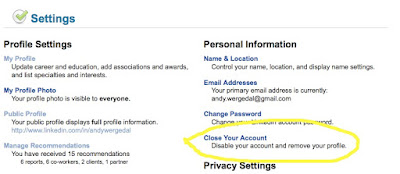
Close an account and remove your profile from LinkedIn by completing the following steps:

  • Log into the account you wish to close.
  • Click on 'Account & Settings' found at the top of the home page.
  • Click on 'Close Your Account' under Personal Information.
  • Select a reason for closing your account.
  • Click on 'Continue'.

Hiring Consultant Warns: "No Connection Between Credit History And Job Performance"

from Consumerist by


Almost half of all employers use credit reports to judge job applicants, even though credit histories have no relation to job performance. Personal finance goofs are only relevant for jobs that deal directly with money—cashiers, account managers, and the like. For everyone else, negative credit reports keep otherwise capable people from securing a job to help avoid further financial problems. So why do so many companies still ask for credit reports?

Hiring consultant Nancy Schuman explains:

Some companies believe they can deduce how a person will handle their job responsibilities based on how they handle their personal finances. Others use the information to gauge how long a person might stay in a position if their debt load is higher than a position pays. It is also used to verify employment history and a social security number.

There is no clear connection between a credit history and job performance, and many job seekers consider it to be an unfair way of screening candidates, however, no Federal discrimination law specifically prohibits employment discrimination on the basis of a bad credit report. The Fair Credit Reporting Act (FCRA) and state credit laws help to regulate how an employer can obtain and use their findings. An employer must gain your consent in writing to do a credit check and the report they receive is different than one viewed by a credit agency or an individual. Full account numbers are not revealed and they won't see a credit score, but they will be able to see late payments, collections and bankruptcies. If you are actually denied employment because of your credit report, the company must notify you so that you may view the report on which the decision was based.

An accurate credit report is best defense against a discriminating employer. Every year, consumers find 13 million errors staining their credit reports. Request a copy of your report from each of the three credit reporting agencies at AnnualCreditReport.com (not FreeCreditReport.com!) Challenge anything that looks like an error. If you can't scrape strikes from your report, talk to your potential employer clearly and honestly and help them understand what led to financial transgression, and explain how it is completely unrelated to your future job performance.

Does Bad Credit = A Bad Candidate [Long Island Press via Fair Credit Reporting Act]