A Simple Truth: Being Genuine Brings Success


being genuine brings success
Photo by the half-blood prince

There's a Chinese restaurant called the Panda Garden that my family used to frequent every Sunday. I recently read in a paper that it had been voted one of the best Chinese restaurants in Lawrence annually. That's pretty impressive, considering there are a slew of Chinese restaurants in the college town.

The annual award might be because of the cuisine, but I have a different theory. I believe the Panda Garden is consistently voted best Chinese restaurant because of the owner.

The owner is one of the most personable people you'll ever meet. Without fail every day, you can see the owner walking around and chatting with every single table, asking how the food is and getting to know her customers.

She isn't friendly because she believes she'll get more business from repeat customers (which she does). You can tell from the moment the owner approaches the table that she's truly interested in how the food tastes and how your day has been. She's genuinely interested in your life.

It might sound like I'm a regular at the restaurant, but the reality is that I haven't eaten there in 15 years. That's how much of an impact the owner has on my opinion of the establishment. I can remember our conversations and how she laughed and chatted with our family nearly every week.

So how does one go about being that genuine of a person? So genuine that they can take a commercial venture and add a couple dashes of character and personality, without feeling forced?

Blending your true personality with business isn't an easy thing to do, if you're doing it for business purposes.

But that's just the rub: If you're only being genuine because you think people like it when you're sincere, then you're really not being genuine, are you?

Hrm.

So how do you know if you're being truly genuine?

Knowing if you're being genuine is one of the easiest things in the world because it will feel natural. In fact, you'll feel wrong/forced/weird/uncomfortable if you're not being genuine.

Have you ever slept on your arm and then woken up with a numb arm? I do this every now and again, and it's one of the weirdest feelings in the world. I can swing my arm around and not feel a single thing. The arm could be somebody else's, for all my nerve endings are telling me.

This is what being insincere feels like: You're wearing somebody else's personality, and it just doesn't quite fit.

Make a List!

I love Jason Teitelman's method for maintaining your genuine self: Make a list of truths about yourself, and display it publicly, where you can see it every day.

(In the event that you're a compulsive nose-picker, it might be prudent to be a little disingenuous and hold off putting "nose picker" on the list. At least the public list.)

Your Roots

Constantly reminding yourself about who you really are helps you stay true to your core self. Your core self is comprised of all the things that have shaped you:

  • your upbringing
  • your location
  • your likes
  • your dislikes
  • your temperament
  • etc., etc., etc….

Being Genuine Like a Politician

Politicians have exploited their background to gain more votes. Maybe they'll bring out an unnatural dialect, or a sudden interest in the local sports team, or anything else they think they can play off of to win more votes.

The problem with this route is that many people see through this and eventually figure out the smarmy, under-handed tactics. Nobody likes having smoke blown up you-know-where. The same can happen if you try too hard to win affection by being insincere.

Think of the stressful lives those people who have built their entire careers around being artificial.

So, in all things.. be yourself, and people will respect you more than if you tried to be someone you weren't.

Other Tips to Being More Genuine

Show emotion

Being genuine is one of the hardest things because it requires you to be vulnerable. Every person has a "face" that they can put on to hide their true emotions. But the fact is, we've come to accept that emotions are weak.

Not to turn into the macho-guy, but think about the movie Gladiator. The main character, (played by Russel Crowe), is purely driven by emotion, and he doesn't try to hide them. It's one of the most endearing qualities about him. It's ok to show how you're feeling. It's healthy.

Note: There are some of you, (don't worry, you know who you are), that might show enough emotion on a given day for five people. There's something to be said for not being too dramatic on occasion.

Show vulnerability

Being vulnerable doesn't mean that you put on a turtleneck, and start weeping and strum a guitar. All it means is that you allow other people to see what you're really thinking and feeling.

Being vulnerable gives others a way to look into your life, to become closer to you because of your openness about some aspect of your life.

And the True Indicator to Being Genuine…

The owner of the Panda Garden could stay at home and manage the "business" side of things remotely. Paying bills, paying employees, marketing, and many other things. But instead she comes every day to the restaurant and chats with everyone. Why? It's because that's what she loves to do. It fills her, and it would feel foreign and awkward if she weren't doing that every day.

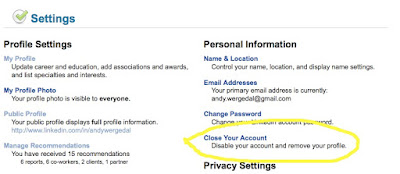
How to close Linkedin account

pic_logo_119x32.png

Close an account and remove your profile from LinkedIn by completing the following steps:

  • Log into the account you wish to close.
  • Click on 'Account & Settings' found at the top of the home page.
  • Click on 'Close Your Account' under Personal Information.
  • Select a reason for closing your account.
  • Click on 'Continue'.

Hiring Consultant Warns: "No Connection Between Credit History And Job Performance"

from Consumerist by


Almost half of all employers use credit reports to judge job applicants, even though credit histories have no relation to job performance. Personal finance goofs are only relevant for jobs that deal directly with money—cashiers, account managers, and the like. For everyone else, negative credit reports keep otherwise capable people from securing a job to help avoid further financial problems. So why do so many companies still ask for credit reports?

Hiring consultant Nancy Schuman explains:

Some companies believe they can deduce how a person will handle their job responsibilities based on how they handle their personal finances. Others use the information to gauge how long a person might stay in a position if their debt load is higher than a position pays. It is also used to verify employment history and a social security number.

There is no clear connection between a credit history and job performance, and many job seekers consider it to be an unfair way of screening candidates, however, no Federal discrimination law specifically prohibits employment discrimination on the basis of a bad credit report. The Fair Credit Reporting Act (FCRA) and state credit laws help to regulate how an employer can obtain and use their findings. An employer must gain your consent in writing to do a credit check and the report they receive is different than one viewed by a credit agency or an individual. Full account numbers are not revealed and they won't see a credit score, but they will be able to see late payments, collections and bankruptcies. If you are actually denied employment because of your credit report, the company must notify you so that you may view the report on which the decision was based.

An accurate credit report is best defense against a discriminating employer. Every year, consumers find 13 million errors staining their credit reports. Request a copy of your report from each of the three credit reporting agencies at AnnualCreditReport.com (not FreeCreditReport.com!) Challenge anything that looks like an error. If you can't scrape strikes from your report, talk to your potential employer clearly and honestly and help them understand what led to financial transgression, and explain how it is completely unrelated to your future job performance.

Does Bad Credit = A Bad Candidate [Long Island Press via Fair Credit Reporting Act]

Use Social Networks Effectively


image via webdesignblog.com

In the current economy, business networking is more important than ever — we need to use lots of different techniques for finding clients. Social networks can be a great addition to our marketing toolboxes. Since I started actively using social networks (only a year and a half ago!), I've reconnected with old friends, and have gotten quite of bit of business that can be directly attributed to connections that were facilitated through these networks.

But social networks can also be great time-wasters, too. However, If you focus on the marketing aspects of the networks, the time spent using them can consist of, as Meryl says, "zero-guilt activities." Here are some tips for using social networks as effective marketing tools.

Join the active networks. There are literally thousands of social networks to choose from (digFoot lists over 3,700). But most are small, not very active, or of interest only in specific fields or geographic regions. I've spent the last month looking at many networks, and have decided that for me, it makes sense to focus on just four.

  • LinkedIn. Often described as "Facebook for business," LinkedIn combines a very large user base, excellent tools for finding connections, and lively discussion groups. Its system for making recommendations is very well-managed. It has so many features that its menu system can be obscure at times, but it's well worth learning to navigate through the site.
  • Facebook. The growth of this network is phenomenal — it's claiming 700,000 new users every day! Even six months ago, most of my Facebook friends were under 30. Now, even we in the older generation have discovered it: I now have almost as many Facebook friends as I do LinkedIn connections, even though I joined LinkedIn several months before Facebook. Facebook is still a much more informal place than LinkedIn, but it's becoming a valuable business tool as Facebook Pages and Facebook Groups (see below) evolve.
  • Twitter. Technically, Twitter isn't a social network, but it can be great for business communication and networking with customers, colleagues and friends. Facebook is highlighting its status update functionality to make it more "Twitterish," so we'll see how the two services compete.
  • Yelp. This review site is new on my radar, but so far, I'm impressed with how active it is (at least in my part of the world). Now that it has a function allowing businesses to provide details of their services, it may become a very useful marketing tool, especially since it is now integrating a way to share reviews on Facebook. It is geographically based, however, and home workers may not want to provide a public street address.

Create pages for your business on LinkedIn, Facebook and Yelp. You may also want to create a Twitter account for your business that is separate from your personal account.

Join groups within the social networks where people you know are likely to hang out. In my opinion, the reason that LinkedIn and Facebook haven't become unmanageable as they've gotten bigger, is that they've encouraged the development of small groups where people can talk about shared interests. Increase your credibility and visibility by using your professional expertise to add to these discussions.

Post frequently, but judiciously. Meryl's comments about Twitter overload applies to the social networks as well. I'll also add that services allowing one to post simultaneously to multiple networks, such as Ping.fm, are great, but should be used carefully. The networks have different audience demographics, and this should be kept in mind when you're deciding what and where to post.

Use the networks' automated tools for finding people you know. The networks can, with your permission, review your address book and see who you know who's already on their network. They also have a "people you may know" function that recommends possible contacts. LinkedIn's system has worked well for me; Facebook's seems to be less accurate. The recommendations presented to you are based on background data (schools attended, former jobs) you provide to the networks, so it's worth the time to provide complete information in your profiles — assuming you are comfortable with their privacy policies.

Use RSS feeds to follow what the members of your network are doing. The folks who run the social networks want you to visit their web sites, of course, but I find it more convenient to follow the activity of my connections through an RSS reader.

Add your Facebook instant message account to your IM program. Facebook's instant message system can be added to multi-protocol IM programs. On my Mac, I prefer Adium; the PC users in my company like Pidgin or Digsby.

Use privacy settings to minimize email notifications. For Facebook, the AllFacebook blog has an excellent privacy primer; note, though, that Facebook is in the process of updating its privacy settings. And check out PC World's discussion of privacy settings for LinkedIn. You'll want to use these settings to control how and when the social networks email you. I find that since I follow the networks' RSS feeds, I can turn off most of their emails.

It's exciting to watch as the social media landscape changes every day. In the near future, it's likely that some social networks will become important business tools, while others will fade away. In the meantime, we can learn how best to use these tools to increase the success of our endeavors.

What Makes a Job Not So Bad


Having an enjoyable job (or, if you are like me, a job that isn't so bad) is not just about what you do. After working in different corporate settings, and being as free spirited as I am, I realize that as long as I work with my mind and not my hands, I will define what I do as moving paper (as one person told me, in the "corporate" world, we move paper from one side of our desks to the other).

The secret to enjoying your job is enjoying the personal dynamics that you create. Having friends at work isn't the only thing that matters. Liking the people you work with, or at the very least respecting them and seeing them as competent, is just as important.

A few years ago, a job hunting website ran a commercial to advertise their services. The premise involved a person was working for a room full of monkeys. At the time I thought: how could it ever be that bad. And then I worked for a job where it seemed that everyone was literally flying by the seat of their pants, with no direction, and looking for someone else to blame. It really was like working in a room full of monkeys. I walked away from the situation afraid to work in my current industry, and afraid of working with people who wore suits in general.

Thankfully, that experience hasn't happened again. And currently, after learning when I was a teenager that "work" was just not going to ever be something I enjoy, I have made creating a positive relationship with the people I work with my goal. I am doing the typical things: seeking to create mentoring relationships that meet different goals, like finding someone to provide career advice, provide advice about balancing career and life, and provide advice about the networking aspect of my career. I think I am getting there. But the most important people I have found in the working world are not the people you would generally think would make or break your career, like a supervisor. The people who make work most bearable for me (and this is a lot coming from someone who feels her calling is to be a socialite) are the people who pass me in the hallways. This includes people who are have more experience than me and supervise me in projects. This includes people who work with the same people, and provide advice on how to deal with situations. This includes people who, when I see them, brighten my day. And this includes people I pass in the hallway who take a genuine interest in the lives of others, as I do too, to create a congenial atmosphere.

Have no illusions; no job is perfect no matter who you work for and work with, and I would never say otherwise. However, I have come to believe that the best metric of a good job is not what you actually do. Which is why I believe that you must give a situation time. The true metric is the relationships and competency you see around you, and I can say from experience that it makes a world of difference even within the same industry.


Two Different Types of Employees

Within any business there are two different types of employees.  There's no difference between a huge corporation and a small business in this aspect - there are still going to be employees that fit these two types.

Type 1 - These employees have an agenda.  They may want to rise up to a higher position, or make themselves more marketable for future opportunities.  They start new initiatives.  They mention their ideas to management about how to improve the company.  They form relationships with coworkers they might not normally interact with.  They lead projects.  They raise their hands in meetings and say "I'll figure it out and get it taken care of."  They make things happen.

Type 2 - These employees literally watch the clock.  They do what their told and then waste the rest of their time sitting around and doing nothing.  They complain to coworkers.  The standard response when asked to do something new is "That's not my job."  They get their work done, but there's no new ideas, no progress or improvement.

I think there are a few employees that fall in between the two types that I mentioned.  Maybe an employee that falls into the second group presents a new idea once in a while.  Maybe one of the best employees gets in a rut for a period of time and just kind of "does his job."

The organizations that are going to succeed are those with the highest percentage of Type 1 employees.  Think about it for a minute.  Are you helping your organization succeed?  What kind of employee are you?


5 Tips For Working Nightshift and Leading a Normal Life


If you work in a business process outsourcing (BPO) industry, chances are that you have to adapt to the business hours of another country. This may leave you working night shifts in a call center more often than not. Here are five tips for working nightshift in the BPO industry and leading a normal life.

If you work in a business process outsourcing (BPO) industry, chances are that you have to adapt to the business hours of another country.  This may leave you working night shifts in a call center more often than not.  Working nights can be difficult for BPO employees, but there are ways to make it an enjoyable experience.  Here are five tips for working nightshift in the BPO industry and leading a normal life:

1. Don't forget to eat and drink. When you are working in the outsourcing industry, it's easy to forget to pay attention to the essential fuels that your body needs.  Carry healthy snacks to work with you during your night shifts at the call center.

2. If you rotate shifts, rotate forward. In the event that your call center allows you to rotate shifts, always rotate forward.  Move from nights to day shift and finally afternoons if at all possible.  This will help to keep your body and mind more in synch through the shift change.

3. Plan time to spend with friends and family. Relationships with others are also an important part of your physical and mental health.  You might be missing out on nightlife because of your work schedule, but that does not mean you cannot build and maintain personal relationships.  During your time off, you can certainly find time to meet a friend for breakfast or lunch or even take a vacation.  If you make a set plan with friends and family, it is easier to make sure that you get enough quality time with them.  Planning ahead will also ease your feelings of isolation and give you fun things to look forward to enjoying. 

4. Set a sleep schedule and stick to it. When you are away from your outsourcing job, you need to follow a set schedule just like you would if you were working the day shift.  Choose a time of day that you want to sleep and stick to it.  If you go right to sleep when you get off, there will still be time to take care of errands during business hours when you wake up.  Likewise, if you stay awake when you get off, you can run errands and take care of business before you go to sleep in the afternoon.  The important thing is to be consistent.  Consistency will help you get a full eight hours of sleep before you return to the call center.

5. Be conscious about fitness. Working night shift tends can take a toll on BPO employees physical and mental wellbeing unless you take measures to incorporate healthy living into your lifestyle.  Just because you are working nights in a call center does not mean that your physical and mental wellbeing should be neglected.  There are many 24-hour fitness centers that will allow you to exercise and stay in shape.