Will Social Security Be Around When You Retire?

Will Social Security Be Around When You Retire?


For those of you outside the U.S. or who don't know, Social security was founded by President Franklin D. Roosevelt in 1935. It has undergone some changes since then, but is essentially a government assistance program to provide retirement, disability, and survivor benefits to beneficiaries funded by U.S. tax dollars.

The Social Security Statement


We just received Linda's Social Security Statement containing her earnings record and estimated benefits. Within the envelope they included a pamphlet titled "What young workers should know about Social Security and saving." I am not planning on Social Security being around when I reach retirement age, because you can only go so long spending $2 when you are only making $1. With all the Baby Boomers retiring, there is just going to be a lot more money going out than what is being contributed. You hear concerns about this all the time, but I was interested to find out what the Social Security Administration had to say about the future of the program.

From the Pamphlet…
Will Social Security still be around when I retire?

Yes. The Social Security taxes you now pay go into the Social Security Trust Funds and are used to pay benefits to current beneficiaries. The Social Security Board of Trustees now estimates that based on current law… In 2017 (it) will begin paying more benefits than it collects in taxes andin 2041, the Trust Funds will be depleted (emphasis added). Because people are living longer and the birth rate is low, the ratio of workers to beneficiaries is falling. Therefore, the taxes that are paid by workers will not be enough to pay the full benefit amounts scheduled.

… Even if modifications to the program are not made, there would still be enough funds in 2041 from taxes paid by workers to pay about $780 for every $1000 in benefits scheduled.

Wishful thinking?

While I am pleased that the government is being honest about challenges ahead for the Social Security program, I think their estimates are very conservative - if not wishful thinking. The way healthcare technology is advancing we will probably be able to keep everyone alive to 100+ in a couple decades - whether they like it or not! ;) I would be surprised to an increase in our birth rate, and I think seeing a continuing decrease is much more likely. So with both ends extending out, we will likely have a much larger disparity of cash inflows vs. outflows than we do today.

But knowing our government, they will try to find a way to make it work. They are going to have to pay the piper eventually, but no one seems to know when that day will come. Assuming they can always find more money to borrow (a dangerous assumption IMO) things will work out fine and we will all get our Social Security checks each month.

Depending on Social Security for retirement

If you can't tell, I do not want to be in a position where I have to depend on the government to be able to retire. When ever people ask me about it, I always tell them the same thing - Plan for your retirement like Social Security will not exist. If it is still around, then you will have a nice little bonus. But a lot can change in a decade or two and in the case of Social Security, I don't think it will be in their benefit.


"

10 Twitter Tools to Effectively Manage your Followers

Original Post: dailyseoblog.com by Mani Karthik
Managing your followers and friends on Twitter is not easy. But its a fact that your success ratio and influence power is directly proportional to how active your followers are. I’ve realized that rather than who follows you or how many people follow you, its important to know whom you are following and how active they are.
Some of the factors that will determine your influence power on Twitter are
- How active your followers are.
- Do they ReTweet your tweets.
- Whether they are regularly updated and have a good following.
- Are those whom you follow, following you back etc.
With the default options on Twitter, its not really easy to manage your followers, but here are some interesting web based applications that I found to be of great help. Hope you find them useful too.
Twitter-tools
Twitter bird icon courtesy – Aravind Ajith
1. Mass Unfollow those who are not following you back with Huitter
I believe that there is no use in following people who aren’t reciprocating on Twitter. I use this tool weekly, to check for people who aren’t following me back. It automatically unfollows everyone who aren’t following you back. Huitter.mass-unfollow-tool-huitter
2. Automatically unfollow all inactive accounts you are following with MyCleener
This is yet another tool that will help us automatically unfollow all the inactive accounts based on when their last tweet was, and help you save your follow number. MyCleener
automatically-clean-inactive-accounts
3. Find out common users following and being followed by two accounts
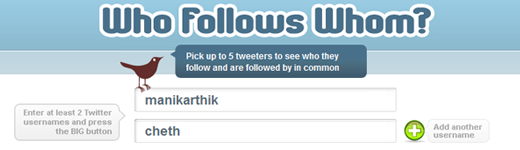
This is a great tool, because if you knew two power user accounts, say from your niche, then you can find out who are the guys they keep in contact with and who are the guys they are following and followed by with this tool. Running this tool with maximum five accounts will more or less reveal the “hidden” circle among them. Very effective if you know whom to stalk. Who follows whomwho-follows-who
4. Manage your friends and followers with tags
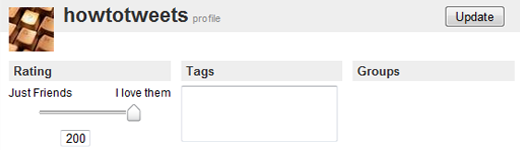
This tool lets you rate and tag your friends and filter them on a timeline! You can also create custom groups of your followers and filter you timeline by that group. Very effective, but a little complicated to use. Twittangletwittangle1
5. Unfollow people who have not updated within “X” amount of days
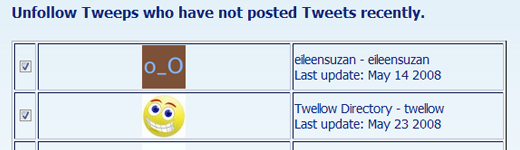
This is one of the best ones out there. It lets you find out the tweeps out of your followers who have not updated within a specified number of days (you can decide how many days is it) and lets you unfollow them. Extremely helpful when it comes to keeping your followers group healthy. Untweepsunfollow-inactive-users
6. Find out which Tweet made you popular and which one un-popular
One of the things that’s frustrating about Twitter is the un availability of a tracking mechanism. I personally would like to know what was that one tweet that got me popular and which is the one tweet after which people unfollowed me. Very effective in finding out what people expect from you and what they don’t. This tool helps you find just that.Tweet Rank (it’s German, you may want to translate it to English.)tweet-rank
7. Find out your ReTweet Rank
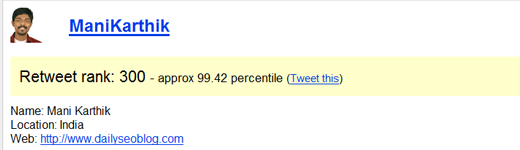
ReTweets I believe are a good measure to find out how popular your tweets are. This site picks up all the re-tweeted stories and grades you based on the number of re-tweets. Though its not sure what the algorithm is, its a nice tool to find out where you stand. Retweetrankretweet-rank
8. Find out who’s following who on Twitter
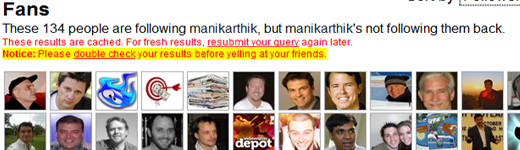
Well basically this tool helps you to find out if those people you are following are following you back or not. Shows you the number of friends, fans and followers. But I use it for a different purpose. If I find out a power user in my niche who is popular and is often re-tweeted, I would like to find whom he is following and what are his sources. Simply use this tool, give in the username and it will show who all are following him, his friends and fans. The good thing is that you can sort them by the number of followers they have. So if you want to steal a power users “precious friends”, this tool comes in pretty handy. ;) Friendorfollowfriendorfollow
9. Find out common followers between accounts
If you’re unsure whether to follow someone or not, just use this tool to find out if you have common interests and whether there are guys you are following in common.TwtrFrndtwitterfriend1
10. Find relevant and interesting Twitter users to follow
As I said earlier, a good twitter life is all about following and keeping in company with the most active and interesting Tweeps. And Mr.Tweet is one damn tool that lets you connect with them. I mean, its a very simple concept executed in an awesome way. It shows interesting profiles and stats such as they are active or not, responds to tweets or not and whether they’ll follow you back. Mr.Tweet
mrtweetMost of these tools require username and password, so use them wisely. Hope you like them.
UPDATE
Thanks to Mark, who introduced this tool called Tweepular to me. I wish I had known them before making this list. It is “the” best tool I’ve found so far. It has almost all the features I can think of for managing followers. Do check it out and you’ll quit using all others.
tweepular


How To Win Your Local Job Fair

From Consumerist

The anonymous, newly unemployed personal finance blogger behind Well-Heeled with a Mission put together a timely, helpful guide on how to avoid wasting your time at job fairs and actually come away with the experience with some positives rather than feel as though you've wasted your time in a cattle call.

Well-Heeled advises you prepare exhaustively for the fair, boning up on the top two or three companies that interest you, focusing on them at the fair, then following up with short, polite e-mails afterward.

The key to it all, she writes, are knowing what you're getting into before you head out into the fray. Here are her top three pre-fair preparation tips:

1. Determine if this job fair is worth your time and effort. Look at the requirements for attendance – for example, some fairs require a 4-year degree, others don't. Some fairs are specialized (i.e. teaching professionals or high-tech workers only), others are general. Look at the location (is it 15 minutes away? 3 hours away?).

2. Go over the company list and pick 2-3 companies that are your top choices.

3. Spend 30-40 minutes researching your top choices, particularly on any programs / specific functions you are interested in. Spend another 10-15 minutes studying a few other companies that you are interested in.

She follows up with some key advice to avoid getting a speeding ticket on the way home. It's advice she says she learned the hard way last week.

Do you have any additional advice for job fair navigating or job seeking in general?

Making The Most Out Of Job Fairs [Well-Heeled, with a Mission]
(Photo: Lisa Pisa)

Old Workers Vs. Young In A Tough Labor Market

Original Post: Consumerist

Forget about mall-walking and midday bingo games. It seems that workers over 55 just aren't interested in retiring. This is problematic for the young people who, under different circumstances, would have replaced them in the workforce.

These observations come from a new Pew Research Center report, which looks at current workforce trends and predicts what may happen in the near future. So why are people over 55 staying at their metaphorical desks? For many of them, it's not because of the hit their investments have taken—it's because they want to stay engaged and relevant.

When asked to identify specific reasons for working, older workers emphasize psychological and social factors: 'to feel useful'; 'to give myself something to do'; 'to be with other people.' Younger and middle-aged workers are much more inclined to cite classic pocketbook considerations: 'to support myself and my family'; 'to live independently'; 'to qualify for retirement benefits'; 'to receive health care benefits.'

Meanwhile, fewer Americans between ages 16 and 24 are employed or looking for full-time work, and they are generally remaining in school because of the number of jobs that currently require college education of some sort. Or because school is a much safer place to be than the job market right now.

Recession Turns a Graying Office Grayer [Pew Research Center] (via Consumer Reports Money)

(Photo: Hitchster)

How To Use Common Sense In The Job Search

From Brazzen Careerist by Andrew Weitsman

So I’m gonna gloss over the whole networking aspect of this, as I think it was covered pretty well in a previous post, and skip right on to the cold-call aspect of the job search, what with the Internets and the classifieds and the trade magazines and so on.
When considering a job to apply for, there are only two questions that one needs to be able to answer:
  1. What kind of work do I want to do?
  2. How far (literally and figuratively) will I be willing to go to do it?
The answer to the first question should come based off of your personal checklist and your prior work experience, education and so on. I’m not saying that it’s a bad idea to apply outside of your comfort zone, but rather to make sure that you have some expertise/logic/reasoning to bridge the different industries. Unless you’re prepared to jump into an entry-level position in your new field, you might want to rethink your options.
According to a recent survey I lost the link to, relocation is becoming more prevalent among today’s workers. And while this may be a good thing for those of you who are afraid of being the only kid on the block to move because of a job, it’s also something to take into consideration in another way. Due to the stressful economy, fewer and fewer companies are helping to fund relocation expenses for new hires, so one may have to weigh the costs and benefits of the move financially first.
Finally, you might have to think about the costs of the job. I’m not just referring to money you might lose paying for the commute, but also the comparative value of the work. What would you lose (besides the opportunity at a different job)? What would you gain (besides employment and money)? It’s essentially a pros-and-cons list, but many people gloss over this step only to be sorry that they didn’t think about these things beforehand. After all, some jobs are almost entirely bad.
As for where to look, there are so many different job search sites that it can be confusing. I am not much of a fan of the Big Two because of the number of unrelated jobs/pyramid schemes/repeated postings that flood their job boards. I’ve made a list of a number of good search sites on the links bar on this site.
You can usually find a website or twitter account devoted to job searches in your particular career field, and in many cases, a social network as well. You can use these sites to find more pertinent job postings in less time than if you were using a generic job search site. Or, you could skip the third party stuff and go straight to the company’s website itself. In many cases, companies will not post all of their available positions on job search sites. So it’s to your benefit to do some industry analysis and track down the business’ web sites to see all of the positions that they really have available.
Does all of this seem a bit elementary? Like stuff that you already know? Of course it does, and of course it is! It’s common sense! But are you using it in your job search?

Don't Say These Things In A Job Interview

Don't hit on the interviewer. Don't ask whether they might be able to discover your past arrests. Don't ask what the company does, or see if they can pick you up when it rains. In fact, here are 43 things you shouldn't say during an interview if you actually want the job.

On the bright side, if you're looking for work try to remember that there are people out there who do say stuff like this, so if you can learn from this list you'll already be one step ahead of them.

"43 Things Actually Said in Job Interviews" [AOL Jobs]

RELATED
"Take A Coffee Break Before Your Next Job Interview"
(Photo: Oskars)

Turning Your Natural Born Talent into a Career

Original Post: Turning Your Natural Born Talent into a Career

Image via RagingRouge

Crystal Cotton says: With 20 years of experience in Human Resources, Recruitment and Staff Development, I‘ve had my share of really bad interviews. I confess, early in my career the bad interview experience could have conceivably been my fault. After all, the interview process can be just as grueling for the interviewer as it is for the interviewee, especially if either are inexperienced, overly nervous or just have poor communication and social skills. But, as I became more experienced, more precise with my questions and more skilled at soliciting critical information without crossing any lines of legality (this takes a great deal of intuitive skill), it became apparent that sometimes…no, most of the time; it’s not me it’s you. Yes, YOU…the ill prepared, inexperienced, unprofessional and inconsiderate job applicant. YOU are the primary reason why you’ve gone on a dozen interviews and were not hired!

Before I move on and explain, let me put in my disclaimer to stave off all the nasty-gram email I am bound to get. The job market is bad and opportunities are few and far in between. There are more job seekers than job opportunities. However, when you are getting interviews but no offers, you must look at yourself more closely. Something could be amiss.

Recently at a round table discussion with several of my HR colleagues, I posed the following question, “assuming all major qualifications are met, what’s the one stand-out thing that makes you think twice, or even disqualify an applicant for hire?” These are the things that make a difference when the playing field between you and another candidate is leveled and now the employer is making character judgments, as a means of finding just the right fit.

Eager to vent and air their pet peeves, my colleagues all chimed in, almost simultaneously. It was like HR harmony as they vocalized their top 5 reasons for not hiring an applicant. It echoed what I’ve personally experienced over the years, and have heard time and time again from employers and recruiters. It’s YOU… and your inability to make a good and convincing impression. This explains why you’ve gone on a dozen interviews and were not hired! Listed below are the top 5 reasons revealed in my informal, unscientific query. Take heed, these are opinions of people who influence and sometimes make the final hiring decision. These are experienced Human Resources Professionals who give weight to these 5 things when deciding who gets hired and who doesn’t.

  1. YOU ARE DRESSING INAPPROPRIATELY: By inappropriate we mean too much cleavage, or too body conscious. It’s a job interview, dress like you have a clue. Tone down the cleavage. Ok, I get that some people don’t have a suit, and no-one’s saying it has to be Armani, but at least put on a blazer. Please remember that flip- flops are traditionally beach wear, and even if they are embellished with rhinestones, or made from the finest leather, they are not appropriate for a job interview.
  2. YOU ARE NOT PREPARED: Did you do your homework? Employers are impressed when you know more about the job than what is on the posting. It shows you have a sincere interest in the job and the company. Take what you’ve learned about the company and formulate some questions to ask at the interview.
  3. YOU CANNOT CLEARLY EXPLAIN YOUR ACCOMPLISHMENTS, GOALS OR POTENTIAL WORTH: This is a key point. So you’ve got skills, but what have you done with those skills which demonstrates your successes? Can you clearly state your goals and align those goals with the company in mind? Worth, in this sense does not mean salary, it means value. What value do you add to the company? What will be your contribution to their bottom line? Know how to express these things and you’re well on your way to your next job or career move.
  4. YOUR RESUME DOES NOT SUPPORT YOUR INTERVIEWING SKILLS: A prime reason to draft your own resume (get the help of a professional if necessary, but know what it says and make sure it accurately reflects your skills and capabilities). When I work with people to re-write their resume, I make sure we do it together, I get their input, and see that the client understands how to present it to employers. Know that the resume is an extension of you and is the first way you are identified by the employer; know it like you know your birth date and social security number.
  5. YOU’VE FORGOTTEN YOUR MANNERS: Never under estimate the power of being polite and just using a bit of common sense. Confirm your appointment, this shows responsibility and interest. If by some freaky chain of events you are late, call. When you get there, apologize and offer some explanation. Let me be clear, your explanation should be short and simple. Save the melodrama for your friends. Don’t interrupt the interviewer when speaking. It might lead the interviewer to think you have control issues. Lastly, say thank you for the opportunity to interview at the end of the meeting and in your follow-up communication.

Believe it or not, these things can be just as important as your skills. Make one of these faux pas and you may still be a contender. Make a few of these at once, and you’ve earned yourself a standard rejection letter. So the next time you go on an interview and things don’t go well, think about what you could have done differently.


Guest Expert:

Crystal Cotton is a career development consultant, President of Crystal Clear Connextions, and author of career blogging site, Job Ready, Job Savvy www.JobReadyJobSavvy.Blogspot.com. She specializes in empowering individuals with communication skills necessary to succeed in the workplace and beyond to create meaningful and intentional relationships. Through communication workshops, seminars, and coaching, Crystal helps people connect, influence, create and achieve career goals. Get Better Communication Skills Now at www.BetterCommunicationSkills.com .

Crystal has a Master’s in Public Administration & Human Resources; a Corporate Training Certification from NYU’s School of Professional Studies, and is the Director of Human Resources for a NYC non-profit.