Your Personal Brand: Labeling and Living on the Generational Cusp | Brand-Yourself.com Blog

The Generational Debate has been a popular topic lately. As Boomers begin looking to retirement, working, recruiting, retaining, and understanding the current and future workforce is and should be an important focus–for managers, human resource professionals, and companies, regardless of their size or volume.

We know (or we should) that Millenials are the largest new and upcoming workforce demographic next to the aging Boomer population. Gen X on the other hand, is much smaller mainly due to the popularity and widespread use of birth control, specifically “the pill” in the 1960′s, but what about those that fall squarely in the middle? You know the cusp?

Cuspers are a term to define those that fall between generations. Cuspers regardless of where they fall are most commonly between Boomer and Gen X or Gen X and Millenials, are those that exhibit traits of both the generations in which they fall in between.

  • Boomer to Gen X Cusper. Those that are born between born roughly 1954-1965. Noteable cuspers include Barack Obama, Bill Gates, and Sarah Palin. They are commonly referred to as Generation Jones.
  • Gen X to Millenial Cusper. Born between 1978-1988. They are commonly referred to as the MTV Generation, Gen XY, or Generation Doom (because of the video game not XY’s pessimistic outlook). Noteable celebrities that fall into this cusper category include Brittany Spears and Lindsay Lohan.

The idea and use of creating labels like generational labels and categorizing those around us has been a characteristic of human beings since the beginning of time. Fields of study like Anthropology, Sociology, and Psychology were created based on our human desire and need to understand others as well as ourselves. I understand and enjoy this process especially since my educational background is Anthropology and Business. Learning about your market demographic as well as your competitors is advertising and business 101. It’s also an important part of being a successful and effective Human Resource leader.

But at what point is there too much of a good thing?

Instead of labeling one another, I encourage a different and unorthodox approach: one of human interaction, engagement, and good old fashioned conversations with your employees, friends, customers, peers, or whomever. Of course, my impressions could be due to the fact that I’m a Gen XY and Cusper myself. At 32 years old, I’m essentially an inbetween who is often mis-labeled and mis-understood. Too old to be a Millenial but too young to be an Xer, I barely remember iconic events like the Challenger Disaster. Cuspers like myself feel extremely comfortable being uncomfortable. Being inbetween and feeling as an outsider to your own generational label among other things is normal.

What are you thoughts on labeling and generations? Is it a necessary evil or a way to make us feel special, different, or just plain uncomfortable?

Photo Credit DC Femella.

Jessica Miller-Merrell, SPHR is known as @Blogging4Jobs on Twitter, is a published author of “Tweet This! Twitter for Business” and is a leading HR blogger and new media strategist. Jessica is a subject matter expert and provides insights in the areas of HR, recruiting, and new media consultancy with her company, Xceptional HR. Her newest project isTexting4Jobs, a text based job board platform recently launched in Oklahoma.

Posted via email from AndyWergedal

Starting Out in Social Media: Social Networking for Business | Brand-Yourself.com Blog

The business case for leveraging social media as a business tool has been made time and time again. Startups to big business use the platform of social media to spread ideas, connect with their audience, and ultimately drive sales.

When working with clients I often am confronted with glossy eyes when talking about the topic of social media. Chances are they’ve read about it in the mainstream media, however, putting it in to action is another thing all together. If you consider yourself a social media fan boy shout hooray and jump to the comments below and give us your fill after skimming this primer, but if you are fall into the glossy eyed category or want to read this basic primer, read below for a primer on how to start out in social media for business.

Social media in itself comprises of many different elements, but two of the most common and important categories:

Blogging for business

Social since inception, blogs were designed and still hold strong as great publishing platforms to create useful content and share it with a wide audience. With built in web feed abilities (RSS/Atom), blogs make it possible to publish content and “push” it out to other services. For an example, see this explanation on Facebook how to import your feed as Notes.

Find your target audience using social mediaPicture your website, and blog in particular, as a hub where all of your social media activity and presence across the Internet should point back to. This is important, as all of the content and important information about your business is no good if no one ever hears about it. Don’t shamelessly self-promote every chance you get, but rather use social media etiquette.

If no one already told you, get your own domain name. Don’t use the subdomain from a service, no matter how much you like it. To sum up other people’s experiences, once you build a great following around and get massive amounts of links to yourawesomewebsite.wordpress.com and then decide to migrate to your custom domain later, its a pain and you lose traffic and followers.  Start off fresh, and get a domain name now. Its cheap and easy, and you will not regret it later. Its OK to have your website hosted on a service like WordPress.com, if that is what you prefer, but use custom domain features.

Social networking for business

No matter what industry you are in, social networking can work for your business. It just depends however, on how you choose to use it and where your audience is. If you are speaking to an older generation, you may have to be crafty and see where they are hanging out. With valuations on the larger social networks sometimes coming out at us with mind boggling numbers (such as LinkedIn’s over $2 Billion valuation), you can bet that the social media research companies are still spewing out reports and research about how consumers and business use these services.

Facebook isn’t just for the cool kids anymore. With over 500 million active users, and 900 million objects made up of pages, whether business or community, and events, they clearly have a lot of activity happening there. Accordingly, businesses are leveraging their platforms to attack their target markets more effectively. Although in the spotlight for concerns over privacy and changes to the way advertisers and marketers can access information, Facebook remains adamant that the information is still in your control.

Twitter boasts a flurry of activity happening each day with many millions of updates from around the globe. From fast breaking news, to still the good old lunch tales, it has a lively and active community of people ready to speak their mind. Businesses may find it challenging to have active “conversations” with their audience on Twitter, only because it seems personal connections make for better success, but many businesses still use the platform and thrive, assuming they are active listeners and are useful.

LinkedIn remains the premier website of social networking for business. With a thriving advertising system, and active groups, there isn’t anything bad to say about using LinkedIn for business, other than it can sometimes be confusing to newbies. I often see profiles that aren’t filled out properly or people let LinkedIn invites build up for eternities before accepting. LinkedIn isn’t just a great living “resume” or CV, its a platform that needs to be used daily, or as often as possible to do things such as connect with other like minded professionals, or find clients and partners. Companies can use it as an excellent passive recruitment tool. It still is the best kept secret in that realm. Spend less on your job searching and just see who is already in your network, connected to your friends and partners.

How to make it happen for your business

As a business, it’s important for you to focus your time on what works best for you. Leveraging these platforms will depend on available talent, time, and resources. Do a bit of research to find out where your target audience is, and spend time with them. You already likely have a great network of contacts, invite them to join you on social networks, make sure they know about your blog, and keep it fresh and alive with relevant content of their interest. Don’t be afraid to experiment: that is what it’s all about. Try new things, don’t let the same old processes get in the way of exploring new ways to communicate and do business. The payoffs are far too great to miss out.

About the Author: An avid inbound marketing strategist, Mark Mathson gets to live his passion every day while consulting on social media marketing.  He enjoys conversing on Twitter and growing and adding value to his network on LinkedIn

Posted via email from AndyWergedal

Social Media Etiquette at Work | Brand-Yourself.com Blog

social mediaYou’ve heard the rumors, the horror stories and the success stories. You know the positives and negatives of using social media for promoting yourself and your business. Though it may seem obvious at times what you should and shouldn’t do, people are breaking the rules left and right.

The ABSOLUTE Do Not’s

Never ever, no matter how bad of a day you’re having, no matter how miserable you are, no matter what life debacles you’re facing, under any circumstances write about how much you hate your job or hate an employer or even fellow employee on the Internet. It doesn’t matter if you’re not Facebook friends or that they don’t follow you on Twitter. The Internet is public domain, and certainly no place to post your every thought and feeling. Even if you think you’re stuck at the worst job in the world, if you value keeping that job and receiving money, don’t complain! Well, you can complain but in private, in person—which can sometimes be a little risky as it is. But there’s no reason to tweet out for all to see that you think your boss is a spawn of the devil. That’s just a do-not-enter zone.

On the other side of the spectrum, don’t become a harbinger of all things work-related. Regardless of whether or not you love your job, your social media accounts shouldn’t revolve around what you’re doing at work this minute, or asking people to spotlight your company on their blog. You’ll quickly go from someone very pleased with their working situation to someone other people on the Internet see as an annoying spammer. Don’t be the person to friend request anyone you see of any importance on Facebook who could bolster your career or promote where you’re currently working. Social media has one key word that’s often forgotten: social! While you should definitely dedicate some time to promoting your business and tweeting articles, it’s also important to interact with people on a friendly or helpful basis. Find people asking questions, and give them tips or strike up the occasional conversation with a friend. It’s not the end of the world to use social media for some entertainment and potential connection making.

Social Media is Your Friend

While some people cower in fear at the thought of tweeting or posting helpful articles on Facebook—especially after hearing about people getting fired because of what they post—it’s important to remember that social media is more beneficial than it is negative. If used correctly, social media can even land you a job! Really, all it takes is some common sense, a friendly attitude and a proactive mindset to make the most out of social media. You need to take your accounts outside the realm of just spamming or delving more into your personal life than necessary. It’s important to remember that although you’re writing and interacting on your personal accounts, you shouldn’t treat it like a free for all. Think of the online world as an extension of the everyday real world. Proper grammar, talking to others with respect and actually providing useful and insightful information is a must if you want social media to work in your favor. Don’t cower away from the Internet, but immerse yourself into blogs, forums, and what have you to promote yourself and your business in a positive way.

Right from Wrong

It’s as simple as right and wrong when it comes to using social media at work. Don’t say anything bad about your business in any way. Even if it’s just teasing, it could still cause some harm. Don’t spam everyone you know constantly with what you and your business is doing; it’s not helpful, it’s annoying. Remember that the Internet is an open forum; people can access basically anything they want, so while your unsettled tweets about your job might not cause any problems now, they could in the future. Make your English teachers proud and spell correctly with complete sentences as much as possible, and use your best manners online. Live by the rule, if you wouldn’t say or do it in the workplace, then definitely don’t post it online.

Posted via email from AndyWergedal

Designing Perfect Cover Letters | EmploymentDigest.net

When it comes to applying for various jobs, you want to have a cover letter that will make you stand out above other applicants. Your cover letter is how you introduce yourself to the company so you want it to be professional.

The first thing you need to do with your cover letter is the heading. You should try to have the cover letter heading match that of your resume. This presents a more uniform look and is much more professional. If you can find out the name of the hiring manager, use it. Address the letter to him or her to make the letter personalized. You should try to do this for all jobs that you apply for but if you do not know that name then you should address in general to the head of the department.

After your heading and introduction you will need to write your opening paragraph. You should keep this specific. Tell the hiring manager exactly what job you are contacting him or her about and why you are the one they should hire. You do not need to go into details here as this is the paragraph that leads you into more specifics.

The main body of the letter should describe your special qualifications and skills that you have pertaining to the job in which you are interested in. To draw more attention to this are, you should use bullet points for your skills, qualifications and special awards as it helps the manager to easily skim through the letter to see if they are interested in you. It also makes it much easier to read, giving just little chunks of information rather than having to read through a paragraph to get to the point.


Bulleted example:

My enclosed resume details the 10 plus years that I have in Customer Service Management which includes the following experience in:

* In house collections

* Training of new employees

* Creating and implementing new policies and procedures


You do not want to make the list too long but as the same time you want to give them a taste of what they will be getting should they hire you. You are showing them what you can bring to the table and what sets you out above the rest. For the most part, your cover letter is how you sell yourself to employers for possible careers with the jobs that they have available.

Your closing paragraph should wrap up the cover letter, pointing out that you will be in touch so that you can set up a time to meet in person. You should also thank the person for their time and consideration. Keep the closing paragraph short and to the point just as the opening. You do not want a letter that will drag on as the employer will lose interest and move on.

When looking into various careers, check out the details of the jobs that are offered in each field. This way you are allowing yourself to have more than one option where employments concerned. The final thing that you need to do with your cover letter is to send it off to the company or more specifically, the hiring manager.

You can do this either by faxing it, emailing it or mailing it my regular mail. If you are mailing the cover letter with your resume, be sure to print the resume and the cover letter on crisp, clean paper. A good bond to go with is about 20lbs. Watermarks are also good to use as they help to make your resume stand out. You should go with white paper but cream colors also work well.

Many people have started their careers by sending out the perfect resume and you can do this too. You just need to make sure that you personalize each cover letter to be specific to the jobs that you are applying for. For the most part, your cover letter can be a universal one so that you can just plug in the name of the company and the hiring manager where needed. This helps a great deal as you will not have to constantly rewrite your cover letter for every application you turn in.

Landing the perfect job starts with making a good and lasting first impression. You can do this by writing the best resume.

By Marcus Lim – Find jobs, careers, and employment info at Seek4Jobs.net.

Posted via email from AndyWergedal

Social Media Etiquette:Ways to Lose Your Job Via Social Media | Brand-Yourself.com Blog

The World Wide Web is a vast place with users from all over the world, but that doesn’t mean what you post privately won’t come back to haunt you. Here are five cases of ex-employees who should’ve just kept their mouths shut.

social media horror stories 1. I’m too sexy for my job…

A female working for a St. Louis area not-for-profit organization led quite the double life. She was the average, presumably “normal” employee during the day, and a sex blogger by night. She describes herself as being “Clark Kent” with keeping her extremely secret sex blog private. Her undoing was using Twitter. I have to hand it to her, as a single mother and keeping her blog anonymous, she probably could’ve gotten away with her unconventional lifestyle had she steered clear of social media. The reasons behind her being fired should be quite interesting to explain to future employees.

social media etiquette 2. Guilty or not guilty? Take my poll!

This has to be without a doubt, one of the worst decisions ever made in making use of social media. A juror in a child abduction and assault case–which is clearly a very sensitive matter and a private issue–in the UK was uncertain of whether or not the defendant was guilty. She was so conflicted with making her decision, she took to her Facebook and asked her friends: “I don’t know which way to go, so I’m holding a poll.” It goes beyond the stupidity of revealing secret case details to a bunch of 200 Facebook friends. With non-existent privacy settings at the time, the information was laid out for any Internet users to see! She was obviously dismissed for breaching a fundamental rule of jury service. Next time, make the decision on your own or with the persuasion of the other jurors.

Social Media Etiquette3. Attention Internet, I want to be fired!

A woman clearly misjudged the innocence of updating her Facebook status to a rant about why she wants to be fired–I mean, why her job is awful. Either thinking her privacy settings would keep her boss and co-workers from seeing her hate-filled post, or simply forgetting they were friends, she was in for quite the surprise to see a few hours later she had in fact been fired. Though for her it was likely a dream come true since she allegedly had the worst boss ever, she’ll go down in social media history of what not to do. It just goes to show you, swearing at your boss and vocalizing your hate for work in a public domain will not make you employee of the month.

social media etiquette 4. Lifestyles of the Rich and the Famous

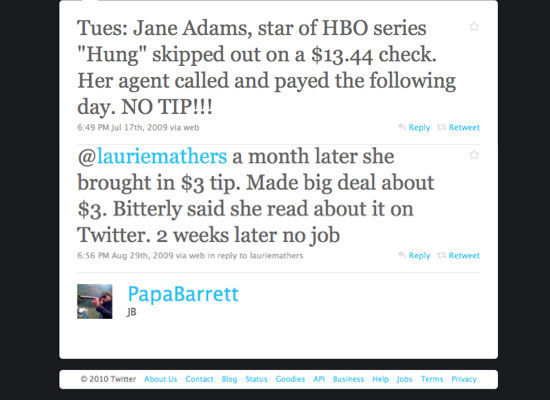
Don’t try to take down the celebrities. It surely will never end well. Waiter Jon-Barrett Ingels found out the hard way when he took to his Twitter to complain about actress Jane Adams, who allegedly skipped her bill on account of having forgotten her wallet. It was later paid, but without tip, to his horror. Well, Jane Adams isn’t one to stand for defamation. She returned, with tip and complaint in tow. Diss a celebrity, get fired. Yet Mr. Ingels definitely didn’t see that one coming, since he bitterly continued to complain on Twitter. Guess it would’ve been smarter to keep your comment off the Internet in the first place. Point one goes to celebrities.

Social media etiquette5. Art is great, no ifs, ands or butts

One of my personal favorites is the story of Stephen Murmer, also known as “Stan Murmur”, whose love of art took him to do unusual things on the web. Though YouTube isn’t always on people’s radar, it can still cause quite the stir, especially if the video goes viral! For this art teacher, his strange…talent and poor disguise branded him a “teacher gone wild on the web” and lost him his high school art gig. While his fame as a “painter” grew, Stephen was able to keep his identity quiet until an interview came out with his true identity revealed. Though he wasn’t fired outright, the board voted to fire him unanimously, saying as a teacher he really wasn’t setting the positive example for students that he should’ve been. The lessons to be learned from Mr. Murmer: don’t post your butt on Youtube for the world to see, even if it is for the sake of an art piece (especially if you’re a teacher, but that should really go without saying) and perhaps keep certain odd talents to yourself.

So there you have it, a list of just some of the weird, the wacky, the equally horrific stories of being fired from social media. Don’t let this be you! Take these ex-employees as examples of what not to do (unless you’re a really good butt artist, but then you should open an art gallery or something and save yourself the extra drama) and there’s no reason Twitter, Facebook or even YouTube can bring you down.

Posted via email from AndyWergedal

The Pivotal Point: Not Giving Up Too Soon

Many of life’s failures are people who did not realize how close they were to success when they gave up. — Thomas Edison

There comes a point when being a business owner gets really hard (and I mean really hard). You’ve come up with your big idea, you’ve done all the initial legwork to set it up, and now comes the hard part: Getting the word out about your business and, more importantly, hanging in there while you get the word out about your business. The hard part now becomes not giving up too soon.

The Real Work

When you start a business, when you start a new product or service, when you launch anything really, that’s when you feel like you’re working really hard. That’s when you’re willing to stay up late and get up early to get all the groundwork completed so that you can start making money. As hard as it can seem during this time, you generally know what to do, or you can at least figure out what to do, and you just plow through getting the work done. Then you finish the work. (Cue sound of crickets.) Now what?

All right, now you figure out that you need a marketing plan. Great, that gives you something else to do! You finish the marketing plan and begin implementing it. (You believe in this plan. You’ve given it a lot of thought. You feel really confident about it. It’s going to generate the business you need.) You run through your plan for several days, maybe even several weeks, and then … nothing. Nothing happens, and in our instant-gratification-seeking world, this is where things start getting testy:

  • When you’re over the rush of your big idea,
  • When you’ve completed the work of creating it,
  • When you need to pay the bills, and
  • When it feels like you’re sitting on your laurels.

When you’re doing all that initial setup (building your website, creating the product, etc.), it feels like real work. Marketing doesn’t feel like real work, and it gets harder to justify and explain to those around us, particularly those who don’t have businesses. Marketing? What’s marketing? Building a website people get; that sounds like real work. Marketing? Marketing on Facebook and Twitter? All right, now you’re just playing around. Those are the conversations you have, both with yourself and with others, for justifying what you’re doing.

Writing posts for your blog, replying and posting on social networks, doing interviews, commenting on other sites and forums, searching for opportunities to guest post — all these things don’t feel like work, but they’re very necessary for building a successful business, and sticking with these activities for the bulk of your time each day for the six months or year it’s going to take you to gain some traction seems impossible.

Not Giving Up

So, how do you do it? How do you avoid giving up too soon?

  1. You make a commitment. Do you want to do this? Are you willing to bet the next 6-12 months of your life on it? You have to be willing to say, “This is my commitment. These are the milestones I intend to reach. This is my intention.”
  2. You maintain discipline. Each and every day, you have to say, “This is what I’m committed to doing. These are my top priorities.” You have to focus on what you believe to be the “highest and best use” tasks that will get the word out about your business and start generating income for you. You stay focused, not only on what you’re going to do, but also on what you’re not going to do (compulsively checking email, surfing the Internet, taking a dozen breaks each day, etc.).
  3. You trust your plan. You’ve given a lot of thought to the best way for promoting your business, and now you just have to believe in it. Don’t keep switching plans and changing things up. It’s going to take time to see results. Give yourself at least a 90-day test with your current plan before doing any tweaking.
  4. Be willing to stay up late and get up early. Although it’s not easy to think about, success isn’t just going to be handed to you. You’re going to have to roll up your sleeves and do the hard work to get things going. No one’s going to do it for you. As you start to get more successful, you still have to continue getting the word out, and juggling priorities can be a challenge. Know that handling incoming work and generating opportunities for future work are equally important.
  5. Find support. Get an accountability partner to help you stay the course. It’s a lot easier to waiver when you don’t have someone else holding you responsible and accountable for your original plans and intentions.

Finding a way to hang in there and not give up on your vision can be the hardest thing you ever do to see your business to success, but you have to figure out how you’re going to stick with it for the time it will take to gain some momentum and start seeing results.

In the past, how did you find ways to hang in there until your idea took hold?

Photo by Flickr user ground.zero, licensed under CC 2.0

Posted via email from AndyWergedal

Lemons, Job Seekers & Opportunities | JibberJobber Blog

I like reading success stories so an artilcle on AOL titled Richest Americans You’ve Never Heard Of piqued my interest.  Maybe it’s too cinderalla or pollyanna, but I found something interesting in the article.  It talks about:

  • Fred Deluca, who opened his first Subway (not called Subway back then) store when he was 17, as well as his investor, Peter Buck, who invested $1,000 to get Fred started.  They are both worth 1.8 BILLION today (good investment, eh?)
  • Jack Crawford Taylor (rich people get their entire name used, apparently), who started Enterprise Rent-a-Car (not called that back then) in 1957. His net worth is 7 billion.
  • David Murdock, who dropped out of high school and now is the chariman of Dole (the food company).  Worth 2.5 billion.
  • Min Kao and Gary Burrell, the founders of Garmin (think: GPS) just a few years ago in 1989.  One is worth 1.6 billion and the other is just worth 1 billion.
  • Clayton Mathile who joined Iams (pet food) in 1970 and became the CEO and chairman, eventually purchasing the entire company.  Worth 1.7 billion.
  • Donald Hall, chairman of Hallmark (son of the founder).  Worth 1 billion.
  • Truett Cathy, owner of Chick-fil-A, worth 1.5 billion. I read his autobiography (delighful).
  • Daniel Abraham, the guy who invented Slim-Mint gum and later launched Slim-Fast, which was sold to Unilever for 2.3 billion. Daniel is now worth of 1.6 billion.
  • William Kellogg, who was a store manager at Kohl’s and eventually become the chairman (good career path, eh?).  He’s worth 1 billion.

As I was reading the brief stories about these people who are worth more money than I can imagine I thought about their early days.

What did they have in common (except for Hall, who was born in the family business)?

  • They took risks.
  • It wasn’t always glamorous.
  • They (probably) went through some very hard times, personally.
  • Some of them may have borrowed and leveraged themselves beyond what they “should have” (or, more than what any family or advisors told them).
  • They were probably lonely many times, working towards a vision that only they understood.

We may see billionaires today but we weren’t with them 20 or 50 years ago when they were struggling, trying to find purpose, believe in a vision, etc.

Right now YOU are struggling, trying to find purpose, believe in the vision of who you are, etc.

DO NOT GIVE UP.  Even if you are a hundredaire or a thousandaire right now you have a journey ahead of you that will take you to different places.   It might not be money that you are after, but if you are in a place where you feel you can’t make a difference, and you want to, just keep on the journey, one foot in front of the other, and you’ll get there… you just have to get through some hard times (and these won’t be the last of them).

One foot in front of the other…

Posted via email from AndyWergedal